
Slime Rebirth: Isekai Awakening Crafting Guide — Kurobe Blacksmith, Recipes, and Materials
Where to craft equipment in Slime Rebirth: Isekai Awakening: the Kurobe Blacksmith tabs, when crafting unlocks, how materials and recipes work, and what upgrade success rates mean.
Quick answer
You craft equipment at Kurobe Blacksmith. Its Craft Equipment tab holds the recipes — Adventurer's Iron Sword, Apprentice Crystal Staff, and Hunter's Steel Dagger are among them — and each recipe lists the materials, counts, and costs it needs. The same forge's REFINE tab turns raw Copper Ore into Copper Ingot, and gear crafting reportedly unlocks once you reach level 15.
- Crafting materials drop as chance rewards from the stages you play, especially story acts and dungeons.
- Stone fragments are smelted and compressed into the bars that recipes actually consume.
- The UPGRADE tab levels up finished gear; the first step shows a 100% success rate, and later steps drop from there.
Crafting is the bridge between the resources you earn in battle and the stats your characters actually fight with. This guide covers where the blacksmith's crafting happens, what each of its tabs does, where materials come from, and what to expect when you push a piece of gear past its first upgrade.
Where to craft equipment
Kurobe Blacksmith is where equipment crafting lives, and its panel gathers the whole gear workflow in one place:
- Craft Equipment — the recipe list. The known lineup includes the Adventurer's Iron Sword, the Apprentice Crystal Staff, and the Hunter's Steel Dagger, and every recipe entry shows its required materials, their counts, and the cost.
- REFINE — raw material processing. This tab converts Copper Ore into Copper Ingot, turning raw ore into the workable form used for crafting materials.
- UPGRADE — powering up gear you already own, covered in detail below.
When crafting unlocks
Gear crafting reportedly unlocks at level 15. On a fresh account the crafting options may therefore stay locked for a while — leveling up is what opens the system, and the beginner guide covers that early stretch. Potion crafting follows the same pattern later, reportedly arriving at level 25.
How crafting materials work
Materials come from playing the game. Clearing stages gives you a chance to pick up crafting items, and story acts and dungeons are the main gathering grounds — the same runs you make for progression and rewards double as farming trips for gear materials. If you run short of something, the fix is usually to run more stages, and the farming guide goes deeper on where to do that. Dungeon runs are a core part of that loop too, as the dungeon guide explains.
Raw drops are not always craft-ready. Stone fragments are smelted and compressed into bars, and bars are the form recipes actually consume. The blacksmith's REFINE tab handles ore conversions, with Copper Ore becoming Copper Ingot. Since every recipe lists its exact materials, it is worth checking which form a recipe names before you craft — ore and ingot are not the same entry.
Exact quantities differ per recipe, and the crafting screen spells them out: material counts and costs appear on each recipe, so you always know what a craft takes before committing. For how the game's wider economy fits together, see the currencies and materials page.
What the recipes give you
Craftable equipment comes in many types and styles, and pieces differ in what they raise. Some examples boost ATK, HP, and defense; others serve a specific playstyle — one example piece is explicitly crit-focused, made to support a crit build. The three named recipes also span different weapon styles: a sword, a staff, and a dagger.
Gear only matters once it is worn. Weapons, armors, and accessories all equip onto characters, and that is the point of the whole loop: gather resources, craft equipment, equip it, and your characters get stronger. The equipment list catalogs the pieces, and the gear-equipping guide covers the equipping steps themselves.
Upgrading gear at the same forge
The UPGRADE panel takes a piece you own and raises it a level at a time — for example, the Adventurer's Iron Sword moving from Lv.1 to Lv.2. Each attempt has a cost: that first step charges Iron Ingot, Magicule, and Coins per attempt, and the panel previews exactly how each stat will change before you spend anything.
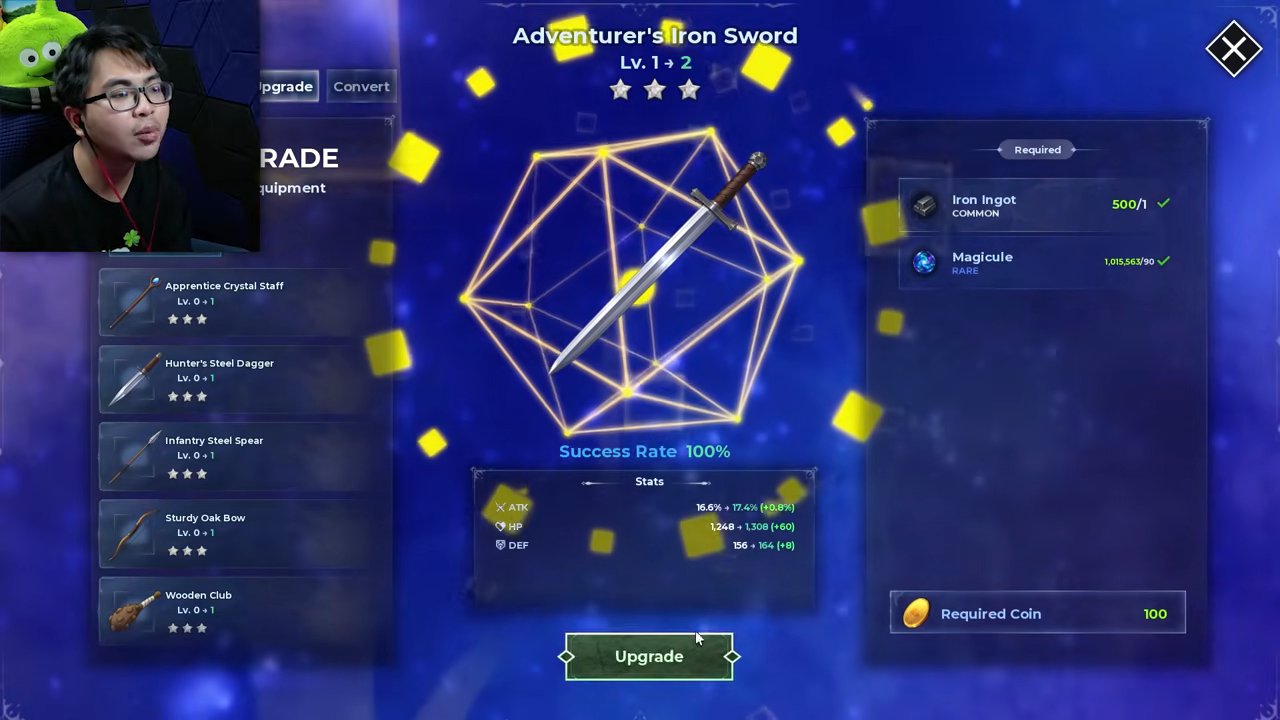
Success is not equally safe at every level. The first step displays Success Rate 100%, a guaranteed upgrade. Beyond that, rates fall: later upgrade levels reportedly read 95%, 90%, 45%, and 30%, and one player pushing past the early levels described a 90% success rate on an attempt and then failed several upgrades in a row. Treat early upgrades as safe and higher levels as attempts — keep spare Ingots, Magicules, and Coins on hand before chasing a deep upgrade.
The full crafting loop
From stage drops to upgraded gear
- 1
Farm stages
Story acts and dungeons give a chance to drop crafting items when you clear them.
- 2
Refine the raw drops
Smelt and compress stone fragments into bars, and run ore through the REFINE tab — Copper Ore becomes Copper Ingot.
- 3
Craft the piece
Choose a recipe on the Craft Equipment tab at Kurobe Blacksmith and pay its listed materials and costs.
- 4
Equip it
Weapons, armors, and accessories go onto characters to make them stronger.
- 5
Upgrade it
The UPGRADE tab raises gear levels for Iron Ingot, Magicule, and Coins; the first step is guaranteed and later ones can fail.
Potion crafting is a separate window
Potions are not part of the blacksmith's gear tabs. Potion crafting runs in its own window, separate from equipment crafting, and it reportedly unlocks at level 25 — later than gear crafting's level 15. The system itself is direct: an example potion from it increases HP by 8%, and crafting completes immediately, with no minigame attached. The potion crafting guide has the details on that side of the system.
Related Guides
Dungeon Guide: Fights & Rewards
The wave-then-boss structure, co-op runs with other players, and the crafting materials you earn for clearing.
Equipment List: Slots & Stats
The Armor, Weapon and Accessories slots on the EQUIPMENT screen, the stats each piece shows, and Kurobe Blacksmith upgrade info.
Currencies & Materials Guide
What Coins, Gems, Magicules and Radiant Coins do, plus ores, Trait Crystals, potions and where each one comes from.